Search This Blog

Sunday, April 9, 2017

How I Became A Ghost, by Tim Tingle -- Day 80


"Maybe you have never read a book written by a ghost before” begins this riveting saga of a boy who is forced to leave his home in Mississippi and walk west with his Choctaw community to where they are being resettled by the government. The book does not relate in detail the historical facts of the Trail of Tears, when Choctaw and other native peoples were relocated due to the Indian Removal Act in 1830 — partly in response to the demand by white settlers for more land — yet readers fully experience the tragedy through the perspective of young Isaac. Author Tim Tingle is an Oklahoma Choctaw storyteller, and his How I Became A Ghost carries the fluid cadence of a traditional tale. Beliefs and traditions of the Choctaw are woven naturally into Isaac’s narrative. We learn the words yakoke (thank you), hoke (okay), and chi pisa lachike (I will see you again, in the future). Choctaws never say goodbye, so the phrase chi pisa lachike takes on a special poignancy when Isaac, knowing from his tragic visions that he will die, says them to his family. Conditions on the exodus west are hard. Many Choctaw die when the militia give them blankets infected with smallpox, and the cold of winter is brutal, but families remain together and resilient in the face of their losses and hardship. Isaac isn’t sure when he will become a ghost; he is uneasy but he knows that as a ghost he will be able, as part of the community of Choctaw deceased, to reach back to help those still living. Indeed he does help when, with Joseph (panther boy) and the little girl ghost Nita, he saves Naomi. What may seem like magical beliefs are very real; the injustice and the events of the ruinous trek will be well understood by readers. Tingle’s great-great-grandfather walked the Trail of Tears in 1835; in 1993 Tingle retraced those steps from Oklahoma to Choctaw homelands in Mississippi, recording stories of tribal elders. Ages 9-12 to adult.

Saturday, April 8, 2017

Inside Out & Back Again, by Thanhha Lai -- Day 79


Inside Out & Back Again is a beautiful and poignant novel about the transition ten-year-old Hà must make when forced to flee Vietnam with her mother and three older brothers at the Fall of Saigon in 1975. Though they have been suffering the deep sadness and confusion of her father missing in action for nine years in the war, Hà relishes her life in Saigon, with lively markets, good friends, and happy traditions. That all changes with their escape to a tent city on Guam, then to Florida and finally to Alabama, where as refugees they are connected with a sponsor. Hà’s experiences are based closely on a pivotal year in the life of author Thanhha Lai. She uses concise but affecting free verse to tell Hà’s story; it captures Hà’s voice and feelings perfectly. Lai tells readers in an author’s note that she sought to convey the emotional heart of her experience as well as the facts: “What was it like to live where bombs exploded every night yet where sweet snacks popped up at every corner? What was it like to sit on a ship heading toward hope? What was it like to go from knowing you’re smart to feeling dumb all the time?” Readers will feel the frustration of learning to speak the confusing language of English, of being teased at every turn for your mistakes in a new culture, of trying to hold on to the best in yourself as you gain strength in a new home. Non-immigrant readers will surely consider what a welcoming generosity could mean to a newcomer. Hà’s first-person narrative is heartbreakingly honest and at turns even humorous; characters are drawn with affecting clarity. A review in The Horn Book Magazine says it well: “Lai’s spare language captures the sensory disorientation of changing cultures as well as a refugee’s complex emotions and kaleidoscopic loyalties.” By the end of the book, readers will feel that maybe, just maybe, Hà and her family will find a true home despite the extreme struggles they have been through. Ages 8-12.

Friday, April 7, 2017

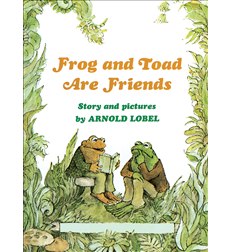
Frog and Toad Are Friends, by Arnold Lobel -- Day 78


Arnold Lobel’s Frog and Toad Are Friends is an outstanding saga of friendship between two very different personalities. Toad – well, he’s a bit grumpy. Frog – always ebullient. In the first of five short chapters for new readers, springtime has arrived but Frog cannot get Toad to arise and enjoy the sunshine even though Toad has been asleep since November.

“What you see is the clear warm light of April. And it means that we can begin a whole new year together, Toad. Think of it,” said Frog. “We will skip through the meadows and run through the woods and swim in the river. In the evenings we will sit right here on this front porch and count the stars.”

“You can count them, Frog,” said Toad. “I will be too tired. I am going back to bed… Come and wake me up at about half past May.”

Frog resourcefully pulls off old calendar pages until he gets to May. Toad awakes exclaiming “Why, it is May!” and runs outside with Frog to enjoy the springtime. This is just the first of the loving and supportive gestures between Frog and Toad. Frog tries to find just the right replacement button for Toad; Toad tells Frog a good story when he is sick; Toad worries about looking funny in his bathing suit; and when Toad longs to receive a letter, you can imagine what happens.

“Dear Toad, I am glad that you are my best friend. Your best friend, Frog.”

“Oh,” said Toad, “that makes a very good letter.”


This, like the other Frog and Toad books, is a simple testament to civilized conflict resolution! Lobel is the well-loved author and illustrator of numerous fine books, receiving the Caldecott Medal and Caldecott Honor award among many others. His stories are gentle and truthful. Ages 4-8.